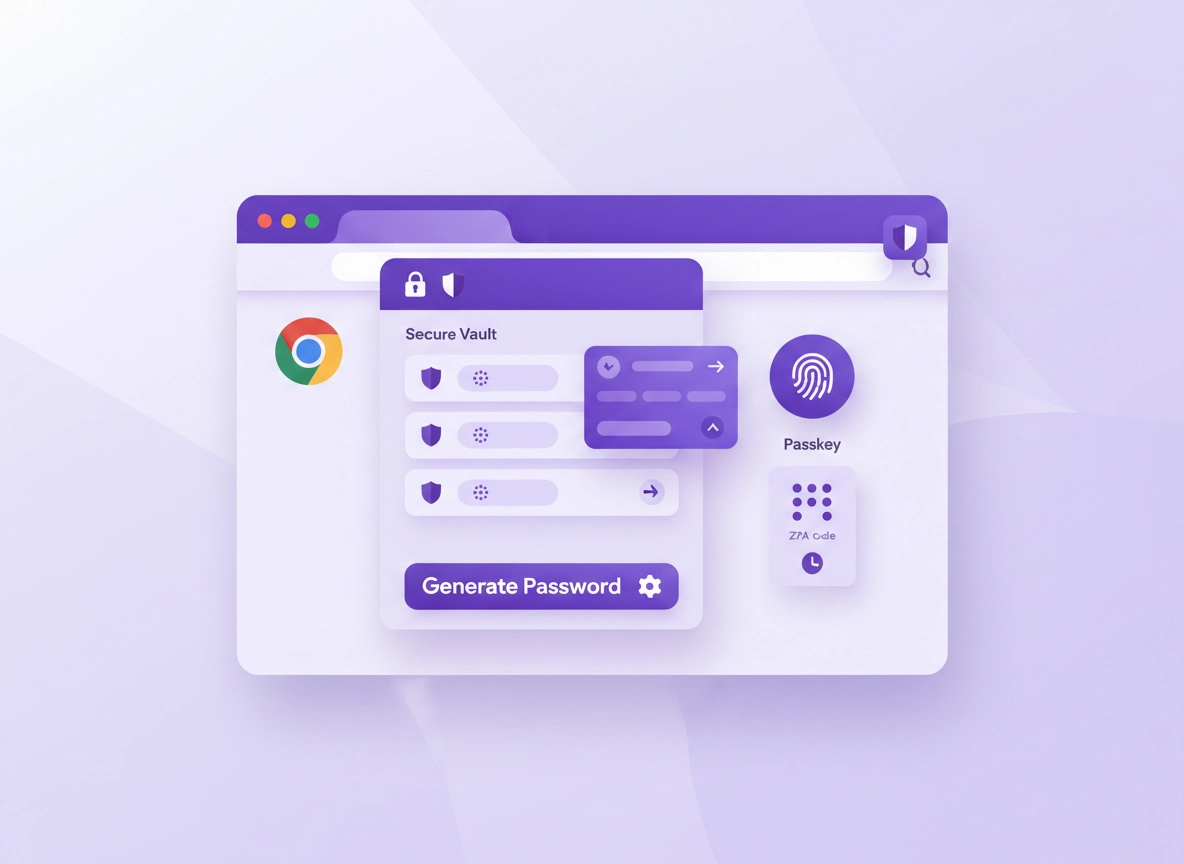
What a Chrome password manager should do in 2026 .
A password manager isn’t just a vault anymore. In 2026, it’s your Chrome sign-in engine.
Chrome can save passwords on its own, but a dedicated password manager for Chrome gives you better control, better sharing, and (usually) stronger security options. The real value isn’t “storing passwords” — it’s preventing the two habits that cause most account takeovers: password reuse and weak passwords. A good manager makes the secure option the easy option: generate a unique password, autofill it reliably, and sync it safely across your devices.
The Chrome extension matters more than the desktop app. If the extension is flaky, you’ll feel it every day: missed prompts, wrong-field autofill, login loops, or “it worked yesterday but not today.” That’s why this guide weighs Chrome autofill quality, passkey support, and security controls as heavily as pricing.
Also: passkeys are now part of the conversation. Passwords aren’t dead (not even close), but a modern Chrome password manager should support passkeys where available while still handling passwords, 2FA, and recovery cleanly.
Related: If you’re deciding between Chrome’s built-in manager and a dedicated tool, start here: Chrome Password Manager vs Third-Party and Chrome Built-in Password Manager Review.
Key terms (quick definitions) .
- End-to-end encryption: Your vault data is encrypted before it leaves your device, and the provider can’t read it in normal use.
- Zero-knowledge architecture: The provider is designed so it can’t decrypt your vault content (it never has your secret).
- Passkeys: A modern login method (often tied to device biometrics) that can replace passwords on supported sites.
- 2FA / MFA: A second factor beyond the master password (apps, security keys, biometrics, etc.).
- Recovery: How you regain access if you forget your master password or lose a device — critical for real life.
- Sharing: Securely sharing credentials without sending passwords in plain text or reusing a single “family password.”
Best password managers for Chrome: top picks (2026) .
These picks focus on what matters in Chrome: extension reliability, autofill behavior, passkey direction, security controls, and everyday usability. “Best” depends on your goal — so you’ll see the strongest use-case for each option.
Top picks at a glance .
| Pick | Best for | Why it wins in Chrome | Watch-outs |
|---|---|---|---|
| Premium all-rounder 1Password |
Most users who want “it just works” + strong sharing | Excellent autofill, strong vault organization, strong sharing workflows, good security posture | No true free plan; premium pricing |
| Best value Bitwarden |
Budget + transparency (great free tier) | Strong core security, reliable extension, excellent value for premium features | UI feels more utilitarian than “luxury” apps |
| Security-first Keeper |
People who want strong controls + business readiness | Security controls, admin options, and polished enterprise workflows | Pricing and add-ons can get complex |
| Polished UX Dashlane |
Users who love slick autofill + simple usage | Clean extension experience, strong everyday usability, helpful security features | Price can be higher than “value picks” |
| Privacy ecosystem Proton Pass |
Privacy-focused users (especially in Proton ecosystem) | Good Chrome experience, privacy-first approach, useful extras like email aliases | Feature depth may differ vs long-established managers |
| Simple + modern NordPass |
People who want a very friendly UI + smooth onboarding | Easy setup, clean design, strong day-one usability | Compare sharing/business needs before committing |
#1 Premium all-rounder: 1Password .
If you want the smoothest Chrome experience with strong everyday features, 1Password is a safe “default pick” for 2026. The Chrome extension is mature, autofill behavior is typically consistent, and it handles real-life needs well: shared vaults, item organization, secure notes, and easy onboarding across devices.
1Password is also a good fit for families and small teams because its sharing model encourages safe behavior: you share vault access, not a single reused password. That’s a subtle but major improvement in day-to-day security.
#2 Best value: Bitwarden .
Bitwarden is the “sensible engineer” pick: strong security fundamentals, a genuinely useful free tier, and premium upgrades that are usually priced far below premium competitors. In Chrome, the extension is reliable and does the job without trying to “over-design” the workflow. If you want maximum value without feeling unsafe, Bitwarden is hard to beat.
It’s also a strong choice if you care about transparency and want a manager whose security model is well understood by the community. The UI is less glossy than some competitors, but the functionality is practical and consistent.
#3 Security-first + business-ready: Keeper .
Keeper shines when you care about controls: strong security features, clear admin options for teams, and workflows that map well to “real IT life” (onboarding, offboarding, policy enforcement). In Chrome, the experience is typically stable, and it’s designed for users who treat credentials like business assets.
#4 Polished everyday UX: Dashlane .
Dashlane is often chosen for the “nice to use” factor: clean UX, strong guidance, and a Chrome workflow that tends to feel seamless once installed. If you want to roll this out to non-technical family members or teammates, a polished UX can matter more than advanced features you’ll never touch.
#5 Privacy ecosystem option: Proton Pass .
Proton Pass is a solid choice if you already use Proton services or you’re simply sensitive to privacy and want a provider with a strong privacy-first reputation. In Chrome, it covers the essentials (vault, autofill, syncing) and includes extras like email aliases that can reduce spam and limit account linking across services.
#6 Simple, modern onboarding: NordPass .
NordPass is a good fit if you want something modern and simple that you can set up fast and understand instantly. That matters because password managers fail most often at the human layer: people stop using them. A smooth onboarding and clean UI can improve adoption.
How to choose: the 10-point Chrome checklist .
Here’s the simplest way to choose the best password manager for Chrome in 2026: score each candidate against these ten points. If you can’t answer a point confidently, that’s a sign you should test the extension for a day or two before paying.
- Autofill reliability: Does it fill correctly on your most important sites (banking, email, work tools)?
- Passkey support: Can it save and use passkeys where supported, without confusing prompts?
- 2FA support: Does it support your preferred 2FA (authenticator apps, security keys, biometrics)?
- Recovery: What happens if you forget your master password or lose your phone?
- Sharing model: Can you share access without sending plain passwords or reusing a “family login”?
- Cross-device sync: Does it work smoothly across Chrome + mobile + desktop?
- Security controls: Can you lock down access (device approvals, session timeouts, alerts)?
- Extension permissions: Does the extension request only what it needs?
- Import/export: Can you migrate in and out cleanly (you should never feel trapped)?
- Pricing clarity: Is the plan simple, or does it become expensive once you add “must-have” features?
Related: Pricing and plan traps happen a lot. Compare before committing: Password Manager Pricing Comparison, Free vs Paid Password Managers.
Step-by-step: setup checklist (secure + smooth) .
This checklist gives you the “best of both worlds”: strong security without breaking your Chrome browsing flow. Do it once, and you’re set. If you manage multiple devices, do desktop first, then mobile.
- 1 Pick your manager and install the official Chrome extension. Use the vendor’s official site or verified Chrome Web Store listing. Avoid “look-alike” extensions.
- 2 Create a strong master password (or passphrase). Make it long, unique, and not based on personal facts. This password protects everything.
- 3 Enable 2FA / MFA immediately. Prefer a security key or authenticator app over SMS if possible.
- 4 Import passwords carefully. If you’re coming from Chrome, export/import only on a trusted device and delete any leftover export files afterward.
- 5 Turn on password generation + save prompts. Make sure it offers a strong generator and prompts to save new logins.
- 6 Fix your “top 10” logins first. Email, banking, Apple/Google accounts, work SSO, and anything that can reset other passwords.
- 7 Clean up duplicates and reused passwords. Use the health/audit feature (if available) and update the worst offenders.
- 8 Set a session timeout that fits your risk. On shared devices: short. On personal devices: balanced. You’re aiming for security without rage-quitting.
- 9 Decide what Chrome should do. Either keep Chrome’s built-in password saving off to avoid conflicts, or keep it on only if you know why.
- 10 Test autofill on your hardest sites. If it fails, adjust extension settings before you assume the tool is “bad.”
What “success” looks like: You can create a new login with a generated password, save it in the manager, then sign out and sign back in using autofill — on desktop and mobile — without confusion.
Related: If you want a deeper “Chrome-specific” workflow, read: How to Use a Password Manager in Chrome and Password Autofill in Chrome Extensions.
Common variations (by device) .
- Windows / ChromeOS: Check that your antivirus/browser protection isn’t blocking extension injection on login fields (rare, but real on locked-down setups).
- macOS: If you use iCloud Keychain + Chrome, decide whether you want two competing autofill systems. Conflicts cause duplicate prompts.
- Android / iPhone: Enable the manager’s autofill service in system settings and test at least one login in Chrome and one in an in-app browser.
Advanced: passkeys, policies, SSO, and zero-trust workflows .
This is where “high value” differences show up. Two password managers can both store passwords. The real separation comes from how they handle: passkeys, recovery, sharing models, policy enforcement, and team access boundaries.
Related: If you’re doing this in a workplace context, don’t miss: Password Manager for Chrome Business, Password Manager for Remote Teams, and Best Enterprise Password Manager for Chrome.
Passkeys in the real world (2026 reality check) .
Passkeys are growing fast, but you’ll still live in a mixed world: some sites support passkeys cleanly, others don’t, and many workplaces still require passwords plus a second factor. Your password manager should handle both without turning your login flow into a puzzle.
- Best-case: You use passkeys for major accounts (email, big platforms) and passwords elsewhere.
- Common-case: Passkeys exist, but you still keep a password fallback and recovery methods.
- Work-case: SSO + device controls often matter more than passkeys (policy is king).
Policies that actually matter for teams .
If you’re managing credentials for a team, features like “vaults” and “sharing” aren’t enough. You want controls that prevent data loss: enforced 2FA, device approval, shared vault permissions, and clean offboarding.
- Offboarding: Can you remove an employee and immediately revoke access without “changing every password manually”?
- Role-based access: Can you give a contractor access to exactly what they need, and nothing else?
- Audit visibility: Can you see who accessed what (without spying on personal accounts)?
- Directory integration / SSO: Does it integrate with your identity provider if you need centralized control?
Chrome vs dedicated managers: when Chrome is “enough” .
Chrome’s built-in password manager can be “enough” if: you’re solo, you only need basic save/autofill, and you’re comfortable staying inside the Google ecosystem. But once you need secure sharing, cross-platform workflows, advanced recovery, business separation, or a more controlled security model, a dedicated password manager becomes the safer, cleaner choice.
- Chrome is enough when you don’t share passwords, don’t manage a team, and want basic convenience.
- Dedicated manager wins when you need sharing, better audits, better recovery, or stronger cross-device workflows.
Related: See the full breakdown: Chrome Password Manager vs Third-Party and Chrome Password Manager Security Risks.
Privacy & security notes (what matters most) .
This is the part most “best password manager” lists skip: your security outcome depends on a few fundamentals. Nail these, and you’re safer than 95% of the internet. Ignore these, and you can have the “best” tool but still get compromised.
Impact: Controls access to email, banking, work tools, social accounts, and password resets.
Related: If you want a plain-English answer first: Are Password Managers Safe for Chrome?
The 6 security fundamentals that matter more than “features” .
- Strong master password: Long, unique, not reused anywhere.
- 2FA turned on: Prefer authenticator apps or security keys.
- Phishing awareness: Your password manager should never ask for your master password via email or pop-ups from random domains.
- Device hygiene: A compromised device can undermine any vault. Keep Chrome and OS updated.
- Recovery planning: Know your recovery options before you need them.
- Sharing discipline: Use shared vaults or sharing features—don’t send passwords in chat.
Recommended baseline settings (safe defaults) .
- Option A (balanced): Enable 2FA, keep a reasonable session timeout, and require unlock for payments/sensitive actions.
- Option B (maximum security): Security key 2FA, short session timeout, device approvals, and require unlock for every autofill.
- Option C (compatibility): Balanced security + allow autofill on tricky enterprise sites, but keep sharing controlled.
Recommended setup by goal .
| Goal | Recommended configuration | Tradeoff | Best for |
|---|---|---|---|
| Balanced | 2FA on, session timeout “reasonable,” prompt before autofill for sensitive sites | Small friction | Most users |
| Maximum security | Security key 2FA + frequent lock + device approvals + strict sharing permissions | More friction | Admins, high-risk users |
| Compatibility | Keep prompts simple, disable competing autofill systems, tune extension settings per site | May accept slightly less strict locking | Enterprise/banking sites |
Chrome hygiene matters too: run a quick checkup: Chrome Security Checkup and Chrome Password Checkup.
Troubleshooting (autofill issues, conflicts, weird prompts) .
Most Chrome password manager problems come from three sources: competing autofill systems, extension permission conflicts, or unusual login pages (SSO, iframes, multi-step forms). Use the fixes below in order.
Related: If you suspect a shady extension is interfering, read: Chrome Extension Security Check and How to Check If a Chrome Extension Is Safe.
If autofill doesn’t show up on a login page .
First, check whether the page uses iframes or custom fields. Many banks and enterprise apps do. Try clicking directly inside the username field and typing one character—some managers trigger suggestions only after field focus events.
- Disable other autofill systems temporarily (Chrome’s built-in saving, other password extensions, iCloud Keychain in Chrome, etc.).
- Make sure the extension is allowed in Incognito (only if you intentionally use Incognito for logins).
- Check the extension’s “autofill on page load” vs “on click” setting—some sites behave better with one method.
If you get duplicate save prompts .
This is almost always a conflict between Chrome’s built-in password manager and your dedicated manager. Decide which one is “the source of truth.” For most people, it should be the dedicated manager—then turn off Chrome’s save prompts so you don’t accidentally save passwords in two places.
Related: Need help deciding? Start here: Chrome Password Manager Limitations and Disable Chrome Password Manager.
If the wrong login fills (same site, multiple accounts) .
This happens when multiple logins share the same domain. Fix it by editing the saved item and adding a more specific URL match or label, or by setting a “default” login for that domain. Also check if the site uses separate subdomains (app.example.com vs login.example.com).
If you’re stuck in an SSO loop .
Corporate SSO flows can break when autofill triggers at the wrong moment. Set that site to “manual fill” (click to fill) and avoid auto-submit. If your company uses managed devices, policy restrictions can also alter extension behavior.
If you need to reset safely (without losing everything) .
Don’t panic-reset first. Start by signing out of the extension and signing in again. If that fails, remove and reinstall the extension (from the official source). Only consider a full vault reset if you are absolutely sure you have your recovery method and export path.
If you suspect malware or a browser hijack: use Remove Malware from Chrome.
FAQ .
-
helpIs Chrome’s built-in password manager safe enough in 2026?It can be “safe enough” for basic personal use if you keep your Google account secured with strong 2FA and good device hygiene. But if you need secure sharing, better recovery controls, cross-platform workflows, or business separation, a dedicated manager is usually a better fit. Start with this review.
-
helpShould I turn off Chrome password saving if I use a password manager?Usually, yes. Two systems competing causes duplicate prompts and accidental “split storage” where some passwords end up in Chrome and some in the manager. If your dedicated manager is your source of truth, disable Chrome saving and keep one clean vault.
-
helpAre free password managers okay?Some are excellent. The key is whether the free tier covers your real needs (devices, autofill, and basic security) without pushing you into unsafe behavior. If you need sharing, business controls, or advanced features, paid plans can be worth it. See Free vs Paid.
-
helpWhat’s the biggest mistake people make with password managers?Weak master passwords and skipping 2FA. Your vault can be strongly encrypted, but if your master password is guessable (or reused) you’re at risk. Second biggest: falling for phishing emails pretending to be support and asking for your master password. Real password managers don’t do that.
Sources & further reading .
- Google Chrome Help Center
- Google Account Security (2FA, device checks)
- NIST: Multi-factor authentication basics
- CISA: Secure Our World (practical account security)
- ChromeThemer: Are Password Managers Safe for Chrome?
Disclosure: This guide is editorial. If tools or services are mentioned, they’re referenced for comparison and user education. Always verify the official publisher before installing any extension.