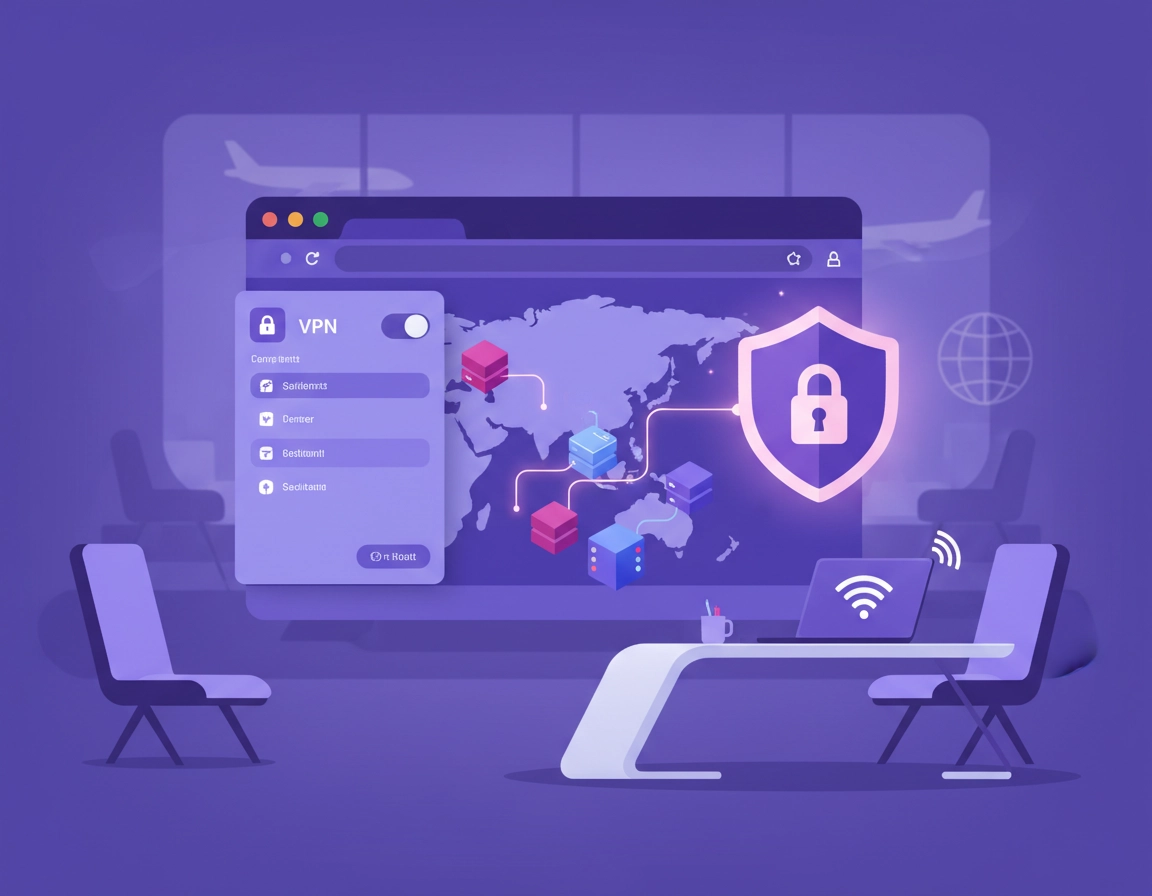
What changes when you use a VPN for Chrome in Asia .
The real difference is not just “privacy on or off.” It is route quality, browser scope, and how your chosen server interacts with the sites you already use.
A lot of low-effort VPN pages talk about Asia as if it were one technical environment. That is too broad to be useful. Chrome traffic from Tokyo behaves differently from Chrome traffic on hotel Wi-Fi in Bangkok, mobile tethering in Mumbai, an apartment fiber connection in Singapore, or café Wi-Fi in Manila. When a user says “my VPN for Chrome is slow in Asia,” the real cause is often one of four things: a poor server route, a captive portal problem, a browser-only protection gap, or a site that does not like abrupt region changes.
The first distinction that matters is browser VPN extension versus full VPN app. A Chrome VPN extension is convenient because it is lightweight and fast to toggle. It is often enough for browsing, web apps, research, reading, and safer use of public Wi-Fi. But it usually protects Chrome traffic only. Your desktop mail client, background sync utilities, conferencing tools, cloud storage apps, and system processes may still talk directly to the network unless you use a full VPN app.
The second distinction is performance versus consistency. In Asia, the physically nearest server is often the best first test for speed, but it is not always the best choice for account-sensitive browsing. Banking, payroll, seller dashboards, fraud-monitored SaaS tools, and enterprise SSO often behave better when your login region stays stable. That means the “best” server is not always the fastest server. Sometimes it is the one that keeps your account behavior looking normal.
The third distinction is privacy versus browser identity. A VPN changes the network path. It does not erase cookies, stored sessions, account logins, browser fingerprinting signals, time zone clues, or extension-level behavior. If you are signed into the same services, have the same browser profile loaded, and keep the same extensions installed, websites can still infer a lot about you even when your IP address changes.
That is why a good “VPN for Chrome in Asia” page should not stop at telling people to click Connect. It should explain when to use a Chrome extension, when to move to full-device protection, when to keep server choice stable, and when the browser itself is the bigger privacy problem.
Useful starting points: Best VPN for Chrome, Secure VPN for Chrome, Chrome VPN Extension Comparison, and VPN Chrome vs Desktop VPN.
Terms worth understanding before you buy anything .
- Browser-only protection: traffic inside Chrome is routed, but the rest of the device may not be.
- Captive portal: the Wi-Fi sign-in page often used by hotels, airports, cafés, and guest networks.
- WebRTC leak: a browser behavior that can reveal network information in some setups.
- DNS leak: domain lookups escape the expected path and expose browsing intent.
- Regional hub: a major nearby server location that often offers the best balance of speed and reliability.
- Account consistency: staying in one expected region so sensitive services do not flag your session.
Before you install anything: checks that prevent bad setups .
The cleanest way to improve this page was not to add more generic advice. It was to answer the specific mistakes people make when using Chrome VPNs across Asia. Most failed setups begin before the VPN is even turned on.
Start by defining the job. Are you trying to protect Chrome on public Wi-Fi? Keep work dashboards usable abroad? Reduce account friction? Stream inside Chrome? Stop location-sensitive services from constantly challenging you? These goals overlap, but they are not identical. A good server choice for browsing hotel Wi-Fi in Kuala Lumpur may be a bad server choice for logging into a bank account that expects you in London or Johannesburg.
Also decide whether you are solving a browser problem or a device problem. If your work is email in a desktop app, Slack outside the browser, Zoom, cloud sync, IDE extensions, or background uploads, a browser extension will not fully solve your privacy exposure. On the other hand, if almost everything you do happens in Chrome tabs, starting with the extension is reasonable and often faster to manage.
Fast pre-flight checklist .
- Update Chrome first: old builds create messy troubleshooting because extension behavior and network handling can change between releases.
- Know the network class: hotel Wi-Fi, apartment fiber, mobile tethering, airport Wi-Fi, and campus networks each fail in different ways.
- Finish Wi-Fi sign-in before connecting the VPN: this matters more than people think on hotels and airports.
- Reduce extension clutter: extra proxy tools, privacy injectors, ad blockers, and script modifiers can mimic VPN problems.
- Think about account sensitivity: finance, payroll, admin dashboards, enterprise SSO, and marketplaces often dislike frequent geography changes.
- Use a clean browser profile if needed: this is often faster than trying to debug months of cookies and extensions inside your everyday profile.
One especially useful mindset for Asia travel is to stop thinking in terms of “country equals connection quality.” What often matters more is proximity to a well-connected regional hub plus the type of network you are currently using. A nearby, well-peered endpoint generally gives a smoother experience than a faraway server chosen only because its location sounds desirable.
Good companion guides: How to Install a VPN Extension in Chrome, How to Use VPN with Chrome Browser, VPN for Chrome Best Settings Guide, and VPN Extension Permissions in Chrome.
Step-by-step setup that works better in the real world .
The goal here is not just “make it connect.” It is to make Chrome behave well on the kinds of networks people actually use while traveling or working around Asia.
- 1 Install a reputable Chrome VPN extension, or install the provider’s full VPN app if you need device-wide protection.
- 2 Join the network and complete any captive portal or guest Wi-Fi acceptance screen before enabling the VPN.
- 3 Open Chrome and connect to the nearest stable regional server first. Do not start with a distant location unless your account or use case specifically requires it.
- 4 Test a normal workflow immediately: open your main work site, one account-sensitive site, and one ordinary content page.
- 5 If something feels off, switch to one nearby alternative region rather than jumping across continents.
- 6 For banking, payroll, enterprise portals, or fraud-sensitive services, keep using one consistent region instead of rotating locations.
- 7 If Chrome behaves well but other apps still leak or bypass the VPN, move to full-app protection.
- 8 Review Chrome permissions, WebRTC behavior, and DNS handling if privacy is a bigger priority than raw convenience.
What a healthy setup feels like: pages load consistently, account logins stop challenging you every session, hotel or airport Wi-Fi no longer feels chaotic, and you are not constantly reconnecting or cycling through random server locations just to keep Chrome usable.
What to choose for common tasks .
- General browsing on public Wi-Fi: nearest reliable regional server.
- Remote work dashboards: low-latency region with clean account trust, usually a nearby hub.
- Banking or payment accounts: same familiar region every time.
- Streaming in Chrome: use the region your account expects, and remember extension behavior can differ from the provider’s desktop app.
- Frequent multi-country travel: keep a shortlist of two or three stable server locations instead of improvising every day.
This is also where browser hygiene starts paying off. The more extensions you allow to inspect page content, alter requests, inject scripts, or manage headers, the less clean your privacy story becomes. Even with a VPN enabled, a cluttered Chrome profile can make the browser feel heavier, stranger, and easier to fingerprint than it needs to be.
Related reading: Chrome Extension Security Check, Chrome Privacy Settings, Chrome Hardening Guide, and Chrome Profile Privacy Setup.
Asia server strategy: speed, account trust, and travel logic .
This is where most “best VPN for Chrome in Asia” articles stay vague, and that vagueness is exactly what makes them useless. Server choice is not a decoration. It is the main driver of whether the VPN feels fast, stable, and believable to the services you log into.
If your goal is raw usability, begin with a nearby major hub rather than a distant prestige location. If your goal is keeping sensitive accounts calm, use the most familiar legitimate region for that account. If your goal is protecting Chrome on hotel, airport, or café Wi-Fi, prioritize a low-latency route over geography experiments.
Why “Asia” is too broad to be a useful server label .
Traffic conditions differ across East Asia, Southeast Asia, and South Asia. The local last-mile network matters. So does the service you are using. A fast general-browsing route can still be a poor choice for a corporate SSO flow, a payment platform, or a dashboard that reacts badly to unfamiliar geography. Chrome users who move between countries should think in layers: nearest clean hub for daily browsing, stable home-style region for sensitive accounts, and device-wide protection for anything outside the browser.
Better server selection by use case .
| Use case | Best first choice | What to avoid | Why it matters |
|---|---|---|---|
| Hotel or airport browsing | Nearest stable regional hub | Distant cross-continent servers | Keeps latency lower on already weak networks |
| Remote work dashboards | Low-latency region with predictable routing | Random daily server hopping | Reduces session breaks and MFA surprises |
| Banking and payments | Same familiar region every session | Country changes every login | Improves account trust and lowers fraud flags |
| Streaming in Chrome | Account-expected region | Assuming extension and desktop app behave the same | Playback behavior can differ by route and product type |
| Nomad-style multi-country travel | Two or three tested go-to regions | Choosing a fresh location every day | Consistency helps both usability and trust |
Another under-discussed issue is that account trust can be more valuable than theoretical maximum privacy. For finance teams, agencies, e-commerce sellers, consultants, and contractor workflows, stability often beats experimentation. Chrome may work technically from many locations, but the sites you use may not love that pattern.
Relevant follow-ups: VPN for Chrome Global Server Comparison, VPN Chrome Performance Test, Fastest VPN for Chrome, and VPN Chrome for Secure Banking.
Privacy and security tradeoffs Chrome users should actually care about .
The strongest reason to use a VPN with Chrome in Asia is not “access” in the generic marketing sense. It is to reduce unnecessary exposure when you browse on networks you do not control. Hotels, airports, cafés, coworking spaces, and temporary apartments are exactly the kind of environments where it is smart to assume the network is not built around your privacy.
That said, a VPN is only one layer. It can reduce how much the local network sees about your browsing path, but it does not remove risky browser extensions, fix messy cookie histories, stop every kind of tracking, or prevent account profiling. A VPN plus a noisy Chrome profile is still a noisy browser.
Impact: Affects Chrome traffic privacy, location-sensitive sessions, DNS and WebRTC exposure, extension trust, and how consistently sites treat your logins.
What a VPN helps with inside Chrome .
- Safer browsing on public or temporary Wi-Fi
- Reduced visibility into browsing routes from the local network
- Cleaner handling of location-sensitive browsing tasks when used consistently
- A more controlled path for Chrome traffic in noisy network environments
What it does not magically fix .
- Cookies and stored sessions that reveal your identity
- Browser fingerprinting and time-zone clues
- Overpowered extensions that can read page content
- Weak account security or reused passwords
- Background apps outside Chrome when you only installed the extension
If privacy matters more than convenience, do not stop at the connection toggle. Check whether your provider handles WebRTC well. Review whether DNS is behaving the way you expect. Keep the number of high-permission extensions low. Consider a clean Chrome profile for travel or finance-related work. That combination is far stronger than simply turning on a VPN and hoping the rest of the browser behaves itself.
Leak and browser-hardening guides: VPN Chrome DNS Leak Test Guide, VPN Chrome IP Leak Protection, VPN Chrome WebRTC Leak Fix, Chrome DNS over HTTPS Settings, and Chrome Secure Wi-Fi Browsing.
Recommended baselines by risk tolerance .
- Balanced: reputable VPN, nearby regional hub, updated Chrome, minimal extension clutter.
- Higher privacy: full VPN app, cleaner Chrome profile, DNS and WebRTC review, fewer persistent logins.
- Higher compatibility: one consistent region, fewer experimental privacy tools, predictable account behavior.
Business and managed-device angle: VPN Chrome Enterprise, VPN for Chrome Device Management, VPN for Chrome Policy Enforcement, and VPN for Chrome IT Admin Guide are better matches than consumer advice when Chrome is policy-managed.
Mistakes that make Chrome VPNs feel worse than they are .
A lot of user frustration is self-inflicted, not because the VPN is fake or useless, but because the setup logic is poor.
- Connecting before the captive portal: this is the classic hotel and airport mistake.
- Choosing distant servers for ordinary browsing: extra latency gets blamed on the VPN instead of the bad choice.
- Using different countries for every session: sensitive accounts notice.
- Assuming browser VPN equals full-device VPN: it does not.
- Stacking multiple privacy tools: proxy extensions, request modifiers, and script blockers can break sites or create false diagnoses.
- Ignoring browser identity: the IP changed, but the cookies, sessions, and extension footprint did not.
Another subtle mistake is letting the page promise too much. A VPN does not make a risky browser safe by itself. It improves one critical layer. That is valuable, but users are better served when the guide explains both the upside and the limits clearly.
Useful comparison pages: VPN vs Proxy for Chrome Differences, VPN vs Private DNS for Chrome, VPN vs Built-In Chrome Security, VPN vs Browser Extension Security Tools, and VPN vs Zero Trust Browser Security Explained.
Troubleshooting slow, blocked, or inconsistent sessions .
When a Chrome VPN session feels unstable in Asia, the fastest way to solve it is to classify the failure correctly. Most cases fall into one of five buckets: route quality, captive portal friction, account-region friction, extension conflict, or protection scope mismatch.
If Chrome gets slower immediately after connecting .
Switch to a nearer region first. Do not start by reinstalling the extension. If you are on hotel, café, or airport Wi-Fi, the local network may already be weak; a distant VPN route just amplifies that weakness. Also disable any extra proxy or privacy extensions for one test round to isolate the cause.
If hotel or airport Wi-Fi looks “broken” only when the VPN is on .
Disconnect the VPN, complete the captive portal sign-in, then reconnect. This is the single most common travel-day failure pattern. The VPN is often blamed for a problem that is really a guest-login sequence issue.
If banking, payroll, or admin portals keep challenging the login .
Stop rotating regions. Use one familiar location consistently. Clear cookies only if necessary. If possible, use a dedicated Chrome profile for that workflow so old location clues and stale sessions do not keep colliding with your new VPN route.
If Chrome works but the rest of the device does not feel protected .
You likely installed a browser VPN extension when your actual need was full-device coverage. Move to the provider’s desktop or mobile app. Chrome-only protection is not designed to secure every process running on the machine.
If a site still seems to know your local region .
That can come from cookies, saved sessions, WebRTC behavior, or DNS inconsistencies. Test again in a clean profile or incognito window. If the behavior changes, the issue is probably the browser state, not the VPN tunnel itself.
If you need a controlled reset .
Disable unnecessary extensions, sign out of the VPN extension, restart Chrome, reconnect to one known-good region, and test only the sites that matter. A selective reset is usually better than deleting your entire browser profile and creating more work for yourself.
Deep troubleshooting pages: VPN for Chrome Troubleshooting Guide, VPN for Chrome Connection Issues Fix, VPN for Chrome Speed Optimization Tips, VPN for Chrome Performance Impact, VPN for Chrome Battery Usage, and VPN for Chrome Data Usage Impact.
FAQ .
-
helpIs a Chrome VPN extension enough when traveling across Asia?It can be enough when your main goal is protecting browser traffic inside Chrome and you do most of your work in tabs. It is not enough when you also care about other apps, background sync, conferencing tools, or device-wide privacy. In those cases, use the provider’s full VPN app.
-
helpShould I always choose the nearest Asia server?For speed, that is usually the best first test. For banking, payroll, enterprise logins, or fraud-sensitive sites, consistency often matters more than raw speed. In those cases, use the same trusted region every time instead of whichever server happens to be closest that day.
-
helpWhy do some sites still seem to know who I am with a VPN on?Because a VPN changes the network path, not your full browser identity. Cookies, stored sessions, account logins, fingerprinting clues, language settings, time zone, and extension behavior can still reveal a lot. That is why a VPN works best with a cleaner Chrome profile and tighter permissions.
-
helpWhy does airport or hotel Wi-Fi often fail with a Chrome VPN?Those networks commonly use captive portals and guest-authentication steps. If you turn on the VPN before completing the Wi-Fi sign-in, the network can appear broken. Connect to the network first, finish the portal step, and then re-enable the VPN.
-
helpCan a VPN for Chrome improve public Wi-Fi security in Asia?Yes. It can meaningfully improve the privacy of your Chrome traffic on shared networks such as hotels, cafés, airports, and coworking spaces. It is especially useful when paired with updated Chrome, fewer risky extensions, and more deliberate login behavior.
Sources & further reading .
- Official Chrome Help Center
- Google Chrome: Incognito mode
- Google Chrome: cookies and site data
- Google Chrome: safer browsing resources
- Chrome Extensions documentation
Editorial note: This page is written as a practical decision guide for Chrome users, not as a generic vendor roundup. VPN quality varies widely across logging policy, extension design, leak handling, server density, app maturity, and compatibility with work-related browsing.